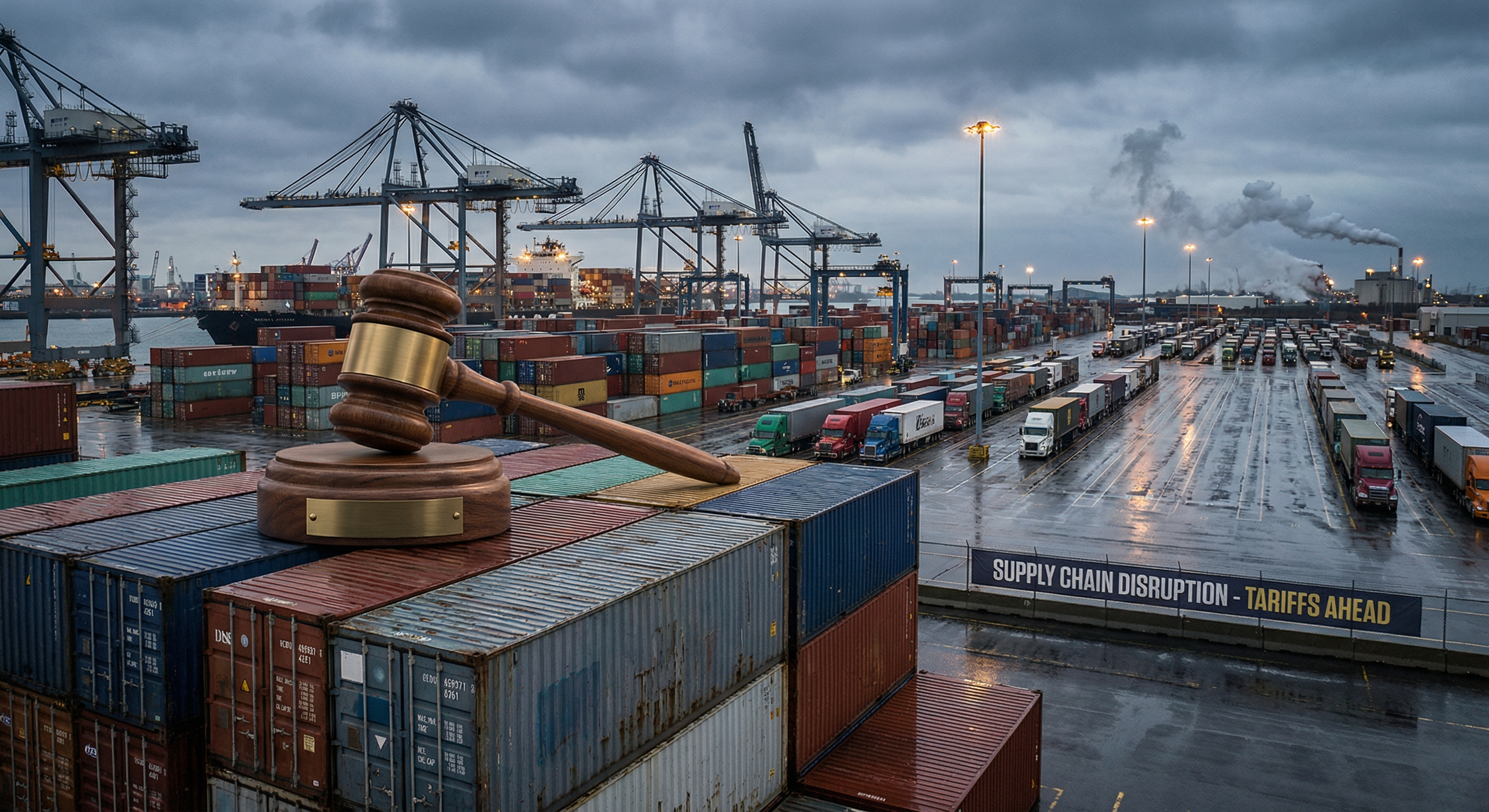
I have always viewed tariffs as a blunt instrument that rarely hits its intended target. The stated goal is usually to punish a foreign competitor or force manufacturing back onshore. The actual result is an immediate tax on American consumers and a logistical nightmare for anyone moving physical goods.
The Supreme Court just blew up the legal foundation of that nightmare, and in doing so, created an entirely new one.
In a 6-3 decision on Friday, the Court struck down the bulk of the administration’s tariff agenda. They ruled that the International Emergency Economic Powers Act does not authorize the president to unilaterally impose tariffs at this scale. The message was straightforward: taxing imports is the job of Congress. Prior administrations had never stretched IEEPA this far, and the Court decided the executive branch had finally overreached.
The Pivot to Section 122
Rather than accept the defeat, the administration pivoted within hours. The president invoked Section 122 of the Trade Act of 1974 to slap an immediate 10 percent global tariff on all imports. By Saturday morning, he raised it to 15 percent, the maximum rate allowed under the statute for a temporary 150-day window.
The IEEPA tariffs are dead, but the 15 percent global tariff is very much alive.
The $175 Billion Question
For operators on the ground, the immediate problem isn’t just the new rate. It is the $175 billion in tariffs already collected under a mechanism the Supreme Court just declared illegal.
Our clients spent the weekend on the phone with their freight forwarders and customs brokers, trying to figure out if they were getting their money back. By Monday, Senate Democrats introduced legislation mandating full refunds with interest within 180 days. The White House pushed back, with the Treasury Secretary pointing out a legitimate complication. If importers already passed the tariff costs onto their customers through higher prices, handing them a full refund now is essentially a massive corporate welfare check.
While Washington argues about the logistics of a refund, the financial markets are already pricing the chaos.
Early Monday morning, claim buyers began approaching importers, offering to purchase their refund rights for 25 cents on the dollar. These are banks and specialty funds willing to hand over cash today in exchange for the right to collect the government refund years from now. As political pressure mounted and legal analysts grew more confident that the government would be forced to pay up, competition heated up. By Monday afternoon, those offers doubled to 50 cents on the dollar.
That is a steep haircut, but a 100 percent jump in a single day tells you exactly how fast the political momentum shifted.
This is what happens when you substitute arbitrary executive action for market mechanics. You do not get better trade deals or revitalized domestic manufacturing. You get secondary markets trading government refund claims while actual supply chains freeze.
For anyone moving freight right now, the environment is pure noise. I see too many operators wasting energy trying to predict what the White House or Congress will do next week. The legal mechanisms have changed, but the fundamental reality has not. You are still operating in a politically volatile environment where your input costs can shift over a weekend.
Focus on what you can control. Maintain optionality in your sourcing, defend your margins, and assume the volatility is permanent. (For background on how we got here, read our analysis of the de minimis exemption’s death and what Amazon’s fee pressure means for sellers.) Everything is still in limbo. It is just a different limbo than it was last Friday.